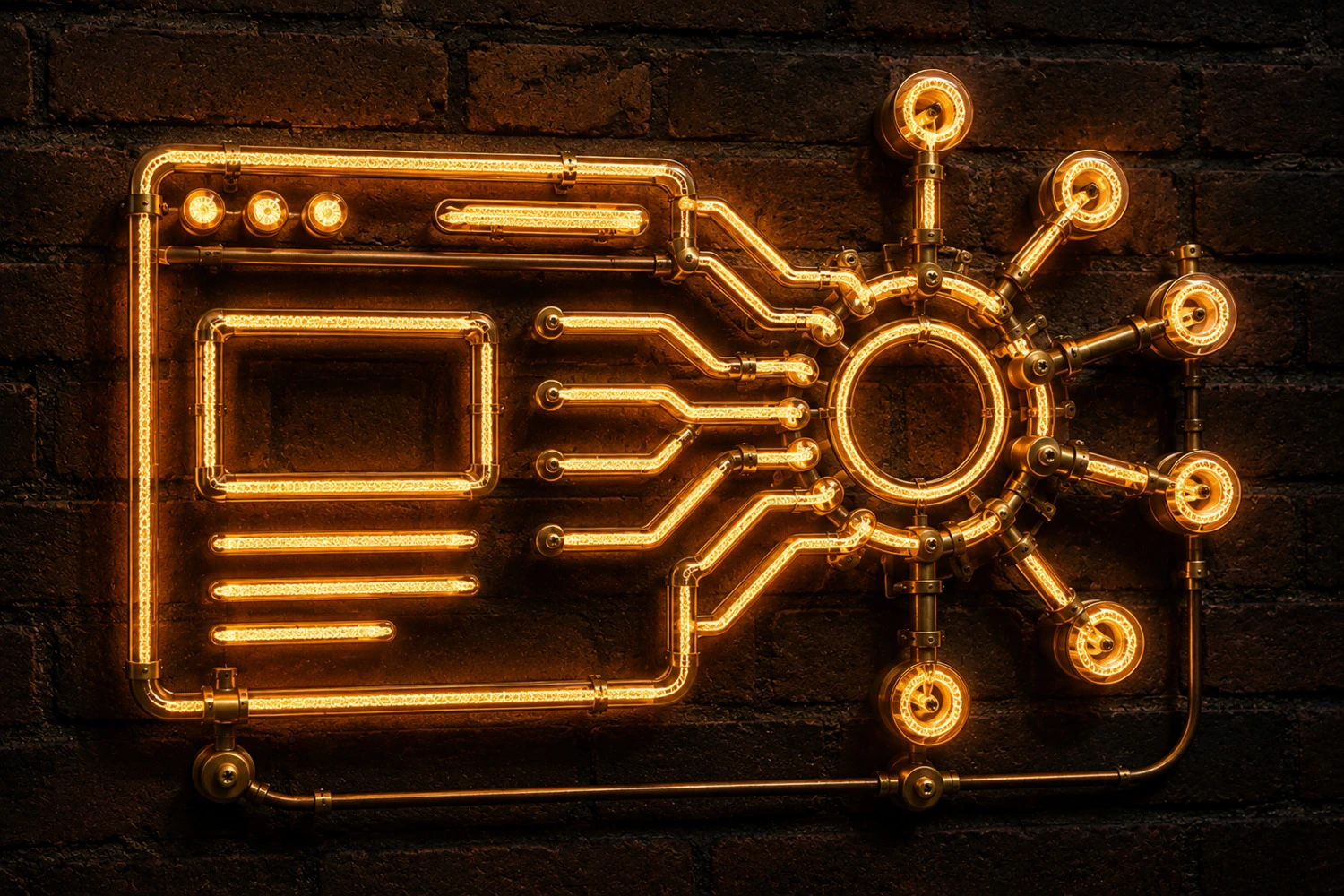
A website presents your business: what you do, who you’ve worked with, how to get in touch. A business platform does work: it answers customer questions, takes bookings, gives clients a portal, passes enquiries straight into your CRM and automates the steps your team used to do by hand. The difference between a website and a web application is that one is mostly read and the other is mostly used. AI is pushing more businesses from the first towards the second, because it makes those platforms faster to build and far more useful once they’re connected.
Why businesses are looking beyond the website
Most organisations run on a collection of tools that grew up separately: a CRM, a helpdesk, a booking system, spreadsheets, an email platform. Each does its job. Together they make teams copy information between systems and switch between applications all day.
A tailored platform brings the parts that matter into one place. Say you run a property maintenance company. Today a landlord fills in a form on your website, someone retypes it into the job system, another person emails a quote, and the landlord phones to ask for updates. On a connected platform, the enquiry creates the job, the quote goes out from the same record, and the landlord checks progress in a client portal. Less retyping, fewer missed jobs and far fewer “any update?” calls.
Strategy comes first
AI-assisted development has made prototypes, interfaces and workflows much faster to produce, so you can see and test an idea early and refine it before the larger investment.
Speed doesn’t decide whether a platform works, though. Discovery workshops, process mapping, a clear specification and technical planning still set out what the platform has to do. After code is generated, it still needs engineering review, security checks, performance work, careful deployment and ongoing maintenance. We explain why in what vibe coding is and why it’s risky for business software.
AI makes a business platform faster to build. Connecting it to your real systems and data is what makes it worth having.
Connected platforms are where AI earns its keep
AI is far more useful when it can reach structured business information. Connected to an approved knowledge base, it can understand the intent behind a question and answer accurately in context. Connected to your CRM, it can qualify an enquiry, look up a customer’s history and trigger the next step in a workflow.
In the property maintenance example, an AI assistant on the portal could tell a landlord exactly where their job stands, because it can read the job record. A standalone chatbot bolted onto a brochure website can’t.
The shift is already happening
Large organisations are already making this move. ABN AMRO, one of the largest banks in the Netherlands, replaced several separate chatbot systems with a single AI platform built on Microsoft Copilot Studio and Azure and connected to its existing digital infrastructure. Microsoft’s published case study reports better language understanding, lower operating costs and fewer customers dropping out of conversations, along with a foundation for future AI work. The principle applies at any size: the value comes from integrating AI into connected systems.
For a growing business, the same thinking can mean replacing a stack of subscriptions with one system built around how you work, as we describe in £10K every year for SaaS, or £10K once for a tailored AI build.
How we approach business platforms
We plan and build connected platforms, from client portals to internal workflow systems, starting with workshops to understand how your business runs and using AI-assisted development with our in-house engineers reviewing and testing every release.
FAQs
What is the difference between a website and a business platform?
A website mainly presents information about a business and collects enquiries. A business platform is a web application that people use to get things done, such as booking, tracking jobs, logging into a portal or managing customer records, and it connects to the systems the business runs on.
What is an AI business platform?
An AI business platform is a connected web application that uses AI to answer questions, qualify enquiries, retrieve customer information and automate workflows, drawing on the business’s own data and systems.
Do I need a platform instead of a website?
Not always. If your site’s job is to present your services and generate enquiries, a well-built website is enough. A platform makes sense when your team spends significant time moving information between systems, or customers need to log in, book or track work online.